


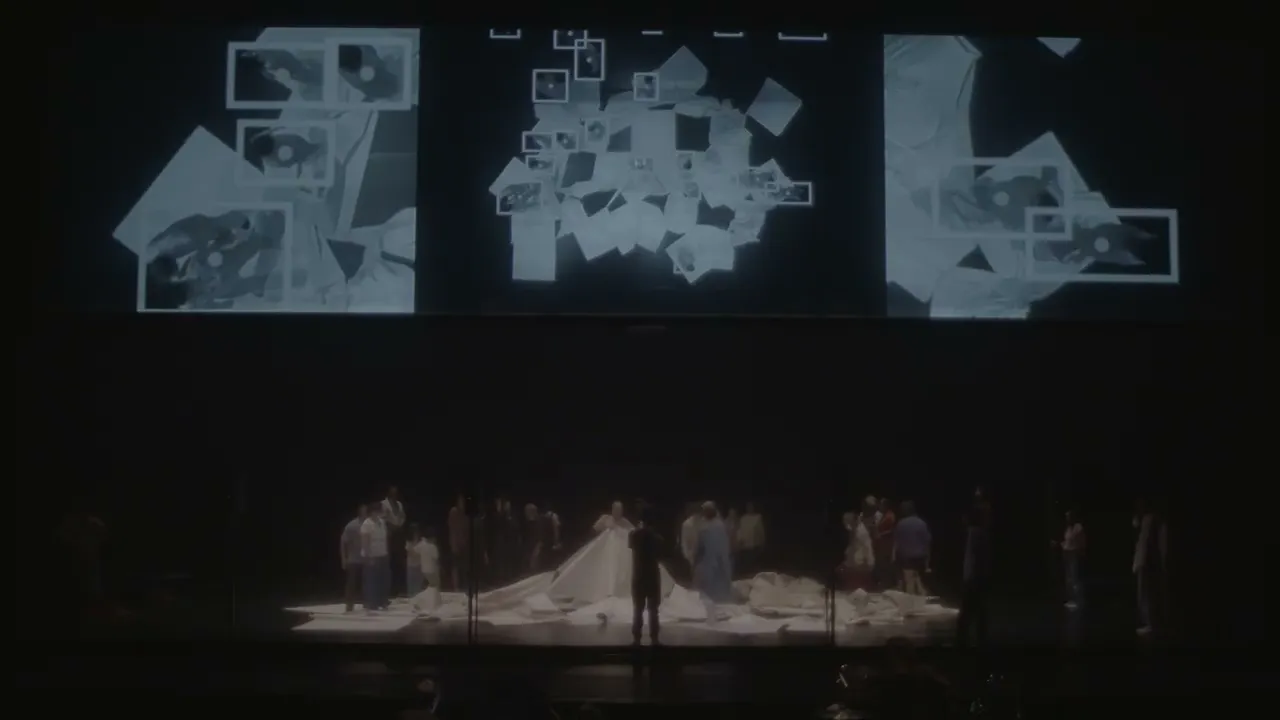
Premiere at Weiwuying, April 2026. Photography by Lee Chia-Yeh.
Premiere at Weiwuying, April 2026. Photography by Lee Chia-Yeh.
Premiere at Weiwuying, April 2026. Photography by Lee Chia-Yeh.
Excerpt from the premiere at Weiwuying, April 2026.
Excerpt from the premiere at Weiwuying, April 2026.
Excerpt from the premiere at Weiwuying, April 2026.
People Concerto
A composed theater and large-scale interactive sound installation.
People Concerto is a performance work that joins composed theater to a real-time, large-scale interactive sound installation, brought into being through the presence, movement, and collective performance of its audience.
The work takes forest ecosystems as its model, where birdsong, wind, water, and insects assemble into an evolving, self-organized soundscape with no conductor and no score. From that image it asks how human movement, technology, and AI-driven sound design might generate musical structure that emerges rather than being dictated. The boundary between stage and audience dissolves, and each visitor stands at once as author, performer, observer, and collaborator.
The piece turns architectural space into an instrument. Yuanyuan Ma's sixty-three hand made fabric squares cover the floor, infrared cameras read the room from above, and an AI system developed with Quanta Research Institute translates the collective behavior of everyone present into sound as it unfolds. Within the squares lie recorded vocal layers from Neue Vocalsolisten Stuttgart and instrumental passages from Ictus Ensemble, and what is heard is decided entirely by how the space is walked: the order in which cells are entered, the distance between a body and the dancer, the stillness or motion of each person, and beneath all of it a hidden layer of arrangement composed by Shiuan Chang.
The governing logic stays fixed while the result never repeats, so that each session sounds once and once only, shaped by whoever happens to be in the room that evening. Dancer I-ling Liu moves among them, folding and unfolding the space, while live playing from Ictus Ensemble and sheng soloist Li-chin Li runs through the field of AI-generated sound.
No one is told they are performing. Yet as people begin to feel that their own movement is making the sound, they go looking for whoever must be in charge of it, wanting to be placed, wanting to be arranged. The work gives its authorship away, and in that giving it lays bare how hard we reach for a center, how reluctant we are to believe the sound could belong to us. What is horizontal underfoot rises vertical in perception, a space built at the scale of a single body, where the sound each of us hesitates to claim turns out to have been ours all along.
People Concerto
A composed theater and large-scale interactive sound installation
People Concerto is a performance work that joins composed theater to a real-time, large-scale interactive sound installation, brought into being through the presence, movement, and collective performance of its audience.
The work takes forest ecosystems as its model, where birdsong, wind, water, and insects assemble into an evolving, self-organized soundscape with no conductor and no score. From that image it asks how human movement, technology, and AI-driven sound design might generate musical structure that emerges rather than being dictated. The boundary between stage and audience dissolves, and each visitor stands at once as author, performer, observer, and collaborator.
The piece turns architectural space into an instrument. Yuanyuan Ma's sixty-three fabric cells cover the floor, infrared cameras read the room from above, and an AI system developed with Quanta Research Institute translates the collective behavior of everyone present into sound as it unfolds. Within the cells lie recorded vocal layers from Neue Vocalsolisten Stuttgart and instrumental passages from Ictus Ensemble, and what is heard is decided entirely by how the space is walked: the order in which cells are entered, the distance between a body and the dancer, the stillness or motion of each person, and beneath all of it a hidden layer of arrangement composed by Shiuan Chang.
The governing logic stays fixed while the result never repeats, so that each session sounds once and once only, shaped by whoever happens to be in the room that evening. Dancer I-ling Liu moves among them, folding and unfolding the space, while live playing from Ictus Ensemble and sheng soloist Li-chin Li runs through the field of AI-generated sound.
No one is told they are performing. Yet as people begin to feel that their own movement is making the sound, they go looking for whoever must be in charge of it, wanting to be placed, wanting to be arranged. The work gives its authorship away, and in that giving it lays bare how hard we reach for a center, how reluctant we are to believe the sound could belong to us. What is horizontal underfoot rises vertical in perception, a space built at the scale of a single body, where the sound each of us hesitates to claim turns out to have been ours all along.
Photography by Lee Chia-Yeh.